Montag, 25. August 2014

Ein dringender Appell des Ordensmeisters der Predigerbrüder an alle Regierenden und die Mitgliedsstaaten der Vereinten Nationen


Excellencies,
None of us can feel untouched by what is happening in Iraq at the moment. What we see happening there is screaming out for solidarity and a coordinated response to stop the extreme violation of human rights against defenceless minority groups who are deprived of their basic human dignity. This is violating International Humanitarian Law and is a crime against humanity. Our own brothers and sisters are among these people who continuously keep us informed of their terrifying plight. The perpetrators are posing a serious threat not only to all the people of Iraq and of all its neighbouring countries but to all of us, as they represent a mind-set and approach to life that, if successful, will attract many more adherents who can imperil any state. While the conflict appears to be about religion, in fact it has nothing to do with religion as God is a God of life and not of death.
We are blessed to have a forum such as the United Nations where commitment exists to build a harmonious and peaceful world. However, many people in fragile situations have become cynical of its operation when their cries for help and protection fall on deaf ears. This current crisis can be an opportunity to break out of a mentality focused only on “our own national interests” to one focused on ensuring the preservation of life and human dignity of every single human being regardless of race, ethnic origin, religion, or any other identity.
We commend the efforts of those countries that are responding to the security and humanitarian needs of the fleeing people of Iraq. However, this is still not enough to ensure their survival. When a state does not have the capacity to control brutal levels of violence that the world agrees needs to be stopped (as is the case now in Iraq), then the international community has an obligation to intervene to remove the capacity of the perpetrators of that violence.
In the light of this, we call upon you and all the Member States of the United Nations
  • to be seized of this crisis in Iraq today and to ensure the immediate deployment of specialist military units from as many countries as possible that have the necessary capacity to stop the ethnic and sectarian cleansing taking place, to ensure the safe return of the refugees to their homes and to bring the perpetrators to justice.
  • to stop the provision of any arms to the perpetrators and to sanction those who continue to provide arms to them.
  • to respond immediately to defuse the humanitarian crisis currently escalating.
  • to protect the persecuted members of minority groups and, according to International Humanitarian Law, to grant them asylum without delay.
  • to put in place immediately conditions for dialogue and peace talks that include all sectors of the society.
We hope and pray that you and your governments will answer to this urgent call.
Fr Bruno Cadoré OP
Master of the Dominican Order (Order of Preachers)
(14 August 2014)
 Issued by Fr Mike Deeb OP, Permanent Delegate of the Dominican Order to the United Nations. Enquiries to mike.deeb@un.op.org

Leider habe ich  nicht die Zeit, diese Texte zu übersetzen - aber ich vertraue darauf, dass sie sich trotzdem verbreiten

Sonntag, 24. August 2014

Ein neuer Brief aus dem Irak


Dear all,

We continue to share our daily struggle with you, hoping that our cry will reach the world. We are like the blind man of Jericho (Mark 10: 46-52), who had nothing to express himself, but his voice, asking Jesus for mercy. Although some people ignored his voice, others listened, and helped him. We count on people, who will listen!
We entered the third week of displacement. Things are moving very slowly in terms of providing shelter, food, and necessities for the people. There are still people living in the streets. There are still no organized camps outside of schools that are used as refugee centres. An unfinished, three story building has also been used as a refugee centre. For privacy reasons, families have made rooms using UNHCR plastic sheets in these unfinished buildings. These places look like stables. We all wonder, is there any end in sight? We appreciate all efforts that have been made to provide aid to the displaced people. However, please note, that providing food and shelter is not the only essential thing we need. Our case is much bigger. We are speaking about two minorities (Christian and Yezedians), who lost their land, their homes, their belongings, their jobs, their money, some have been separated from their families and loved ones, and all are persecuted because of their religion.

Our church leaders are doing their best to solve the issue. They have been meeting with political leaders, with the President of Iraq and Kurdistan, but initiatives and actions of these political leaders are really slow and modest. Actually, all political meetings have led to nothing. Until now, there has been no decision made about the current situation of the displaced minorities. For this reason, trust in the political leaders has diminished, if it exists, at all. People cannot tolerate it anymore. It is too heavy of a burden. Yesterday, a young man expressed that he would rather die than live, without dignity. People feel that their dignity has been stripped from them. We are being persecuted because of our religion. None of us ever thought we would live in refugee camps because of that.

It is hard to believe that this is happening in the 21st century. We wonder what is exactly happening. Is it another plan or agreement to subdivide Iraq? If this is true, by whom and why? Why are the events of dividing the Middle East, that happened in 1916, being repeated now? At that time it was a political issue and innocent people paid for it. It is apparent that there are sinfully, cunning people dividing Iraq, now. In 1916, we lost seven of our sisters, many Christians died, and more were scattered. Is it just circumstance we face this division again, or is it deliberate?
However, the struggle is not only in the camps, with the displaced people. What has happened in our Christian towns that have been evacuated is even worse. The IS forced out of their homes those who did not leave their towns up to the night of August 6th. Yesterday, seventy-two people were driven out of Karakosh. However, not all of them arrived; those who arrived last night were in miserable condition. They had to cross Al-Khazi river (a tributary to the Great Zab) on foot because the bridge had been destroyed. There are still quite few on the side of the riverbank. We do not know when they will make it to Erbil. It depends on the situation and negotiations between the Peshmerga and the IS. There are some people who went to fetch the elderly and the unable to walk. One of our sisters went to bring her parents, and told her story. Another woman, said that she was separated from her husband and children, and she knows nothing about them; they are probably among the others who are on the other bank, or they might be among the hostages taken by the IS. Also, a tree-year old daughter was taken from her mother’s lap, and she also knows nothing about her. We do not know why the IS are sending people out of Karakosh, but we have been hearing from those who just arrived, that IS are bringing barrels into Karakosh and the contents are unknown.
In addition, we know of four Christian families who are stuck in Sinjar for over three weeks; they are probably running out of food and water. If they do not get help, they will die there. At the present, there is no contact with them, and there is no way to negotiate with the IS. 

As for our community, we know that our convent in Tel Kaif is being used as an IS headquarter. Also, we know that they had entered our convent in Karakosh. Those that recently arrived have stated that all the holy pictures, icons, and statutes are being destroyed. Crosses have been taken off the top of churches and they have been replaced with the IS flags. That is not only in Karakosh and Tel Kaif.  In Baqofa, one of our sisters heard the situation was calm, so she went back with few people, to get her medicine. She found the convent had been searched; everything was open and strewn across the rooms.  The minute they entered the convent, three bombs hit the town.  They left immediately.

Apart from what is happening to the Christians, yesterday, Friday the 22nd, a Shiite suicide bomber and gunmen attacked Sunni mosque of Abou Mussab in village under Iraqi government control in Diyala province leaving 68 dead. It is heartbreaking to hear about people get killed while praying. In terms of Media and news release, this massacre overshadowed what is happening to the Christians in Nineveh Plain. We are afraid that our struggle will become only our own affairs, and it will not have impact on the world anymore.

At last, we have to say that people are losing their patience. They miss everything in their hometowns: churches, church bells, streets, and neighborhood. It is heartbreaking for them to hear that their homes have been robbed. Although they love their towns, most people are now thinking of leaving the country so they can live in dignity and have future for their children. It is heard to have hope in Iraq, or to trust the leadership of the country.     
Please, keep us in your prayers.

Sister Maria Hanna OP
Dominican Sisters of Saint Catherine of Siena-Iraq

P.S. Please share the letter with other people. Let the world hear the cry of the poor and the innocent.

- Siehe hier 

Freitag, 15. August 2014

Gebetskette für den Irak

Auf dem Blog der Dominikanerinnen von Bethanien wird gerade eine Gebetskette für den Irak organisiert. Man kann sich noch beteiligen.

Donnerstag, 14. August 2014

Ein Brief aus dem Irak

Die Dominican Sisters of Saint Catherine of Siena im Irak haben diesen verzweifelten Brief an die Ordenskurie geschickt, die ihn auf ihrer Internetseite op.org veröffentlicht hat. Weil er dort kaum gesehen wird, stelle ich ihn hier ein. 

Lesenswertes zum Thema auch hier und hier


Dear Sisters, Brothers and Friends,

You might be surprised that we are writing this letter so soon since you received the last one. But events are happening so quickly here shocking everybody because of its brutality and cruelty. On the night of the Feast of Transfiguration shooting started after mid-night, and continued until noon of the next day. On the morning of the sixth of June many shells fell on Karakosh. Between 8:30 and 9:00 a shell fell on a house and it killed two boys (nine and five years old) who were playing in the garden; and it also killed a 37 year-old woman who was trying to pull water from the pipes. This caused many people to leave the town for their lives. On the afternoon almost all people who remained went out for the funeral of the victims at the church. Although atmosphere of the funeral was sad and calm, it was obvious that people were scared of something would happen.

On the seventh of August we gradually started to understand that the Peshmerga, who were supposed to protect Karakosh, were pulling out, leaving the town unprotected. Everybody was shocked because Kurdish government promised to defend Karakosh, and the other Christian towns. At the same time, ISIS started to get closer to Karakosh and the residents stared to leave the town. As a community, in no time we were to prepare to leave; we took the least with us unaware of what to take and unable to comprehend what was really happening. There were thirty sisters left Karakosh in three cars, and two families accompanied us, as they had no place to go. Three Franciscan sisters came with us, too. When we left the convent, we were surprised to see a big number of people leaving the town on foot. Moreover, it was strange to see only very few guards at the checkpoint when we were leaving the town.

We were not alone on this, other towns shared the same horror. Christians from fifteen villages among them Karamles, Bartela, Bashiqa, Telkaif, Baqofa, Batnaya, Telusquf were forced to leave their homes because ISIS was advancing. Our sisters also left their convents in these towns. In Telkaif, while a young man (Lugin) with a young priest were trying to help a lady who was not able to leave on her own, he was shot and killed by the ISIS. Our exodus started at 11:30 pm, and before that we decided to pray and have the Holy Communion so that if the ISIS entered the house, it will not be defiled. But on the last minute, we decided to leave one piece in the tabernacle praying it will protect the house and the town.

When we arrived to the intersession of Mosul-Erbil, we were shocked to see a huge mess of cars driving very chaotically to Erbil. The view was beyond describing, as words cannot fully capture it. Men, pregnant women, children, handicaps and elderly were moving toward Erbil. There were Christians, Muslims Shiites, Yezeds and Shabak; some people were on foot, some were riding trunks of pick-up, lorry trunks, and motorcycles. There are three checkpoints to arrive in Erbil. It took us five hours, from mid-night to five o’clock, to pass the first one; we reached the second one at seven o’clock and the third one at eight thirty. We arrived the convent at 9:30 exhausted emotionally, physically and mentally. What we saw was unbearable; people were suffering for no reason but because of their sect, religion and trace. We felt like we were in a nightmare wishing that someone would waken us up or that when the sun comes out it will be all over. But it was not the case, we were actually living a hard reality.

It usually takes an hour and 15 minutes to drive from Karakosh to Erbil, but the day before yesterday, it took us 10 hours. It was very hot that night, and because it was very crowed many cars were taking side routes. This caused Upon arriving in Erbil, we saw a big number of people from doomed towns that we mentioned above; there were a lot of people in the streets in the heat of summer sun, with temperature rising over 45 degrees waiting to find a place to stay. Many family welcomed people in their homes and churches but still so many people are staying in parks even in streets and under every tree for shading. These people are way more than Erbil can house, neither can the church meet their needs.


We also learned that there were about a hundred people left in Karakosh who decided not to leave and we learned from them that the ISIS entered and took some houses as a center for them. They also walked in the street saying Muslim prayer “Allahu Akbar”.   Since there was no room for all sisters who came from Karakosh and Bartela to stay in the convent, about half of us are staying in the Chaldean Seminary for which we are really grateful. At the same time, many families preferred to stay in the garden of the convent rather then staying in the street so we provided tents for them. Our sisters from other doomed towns also left their convents and headed to other Kurdish towns. We cannot say what will happen; how long people will stay like this or what the ISIS will do to our towns or if we will ever be able to get back home. Everything is so unclear. The situation is extremely difficult. For the time being people have some money to support themselves, but no one knows how long they will endure with the little they have.

As for the safety, Erbil is a Kurdish city and most refugees are staying in Ankawa that is a Christian suburb and protected by Peshmerga. It is hard for people to believe that even this city is safe that’s why they are thinking more and more to leave the whole country.  You may ask what the world can do for us. We would say, stop the blood, stop the oppression, and stop violence. We are human beings here; stop making us target for your weapon. The world needs to stand as one to protect minority against the evil and injustice. People want to live normal life in peace and dignity. Please help us out to stop the evil.

Dominican Sisters of Saint Catherine of Siena –Iraq - 


Samstag, 26. Juli 2014

Ausflug ins Elsass: Kreuze bei Altenstadt, Schaefferey, Riedselzt, Schafbusch

Von den Rheinauen lockt ein Ausflug über die Grenze ins nahe Elsass.


19. Kreuz bei der romanischen Kirche Saint-Ulrich in Altenstadt, heute ein Ortsteil von Wissembourg Die Kirche stammt aus dem 11./12. Jh und ist  die älteste romanische Kirche im Elsass. Mehr Bilder hier und hier


20. Südlich von Altenstadt an der D244 findet sich dieses Kreuz


 21. und im Feld an der D74 diese vermutlich unvollständige aber sehr schöne Kreuzigungsgruppe. Die Gestalten sind etwas rätselhaft. Die Figur neben dem Kreuz sieht fast schon etwas ägyptisch aus, hat die linke Hand auf die Brust gelegt und hält in der rechten etwas, das aussieht wie - eine Clutch?  Vermutlich ist es aber ein Buch als Attribut des Evangelisten Johannes.
Die Figuren im Kreuzsockel könnten die hl. Familie sein oder Anna selbdritt


22. Dieses Kreuz steht ebenfalls südlich von Altenstadt bei Schaefferey. Die Nase des Gekreuzigten ist abgeschlagen. Die Inschrift ist auf dem Foto nur teilweise lesbar. Einweihung ... 14. Mai 1922.


23. Kreuzigungsgruppe bei Riedselzt. Die Inschrift lautet (soweit lesbar): Jesus sprach zu seiner Mutter: sieh deinen Sohn. Zu seinem Jünger sagt er: sieh deine Mutter ...


24. Ein Sandsteinkreuz mit Metall- oder Holzkorpus und ungewöhnlichem Sockel in der Nähe von Schafbusch. Leider ist auch hier die Inschrift nicht lesbar.

Sonntag, 29. Juni 2014

In den Rheinauen und im Bienwald: Kreuze und der Erlöser in der Baumkrone in Rheinzabern, Steinfeld, Schaidt, Büchelberg, Hagenbach


8. und 9. Leider findet sich in Album 18 kein Hinweis darauf, wo in Rheinzabern diese beiden Steinplatten mit je zwei Kreuzen und der Jahreszahl 1783 in welche Mauer eingelassen sind und was sie bedeuten. Rheinzabern liegt in den südpfälzischen Rheinauen, wo auch fast 200 Jahre nach Beginn der goßen Rheinbegradigung der ehemals mäandernde Flusslauf durch viele Altrheinarme sichtbar ist


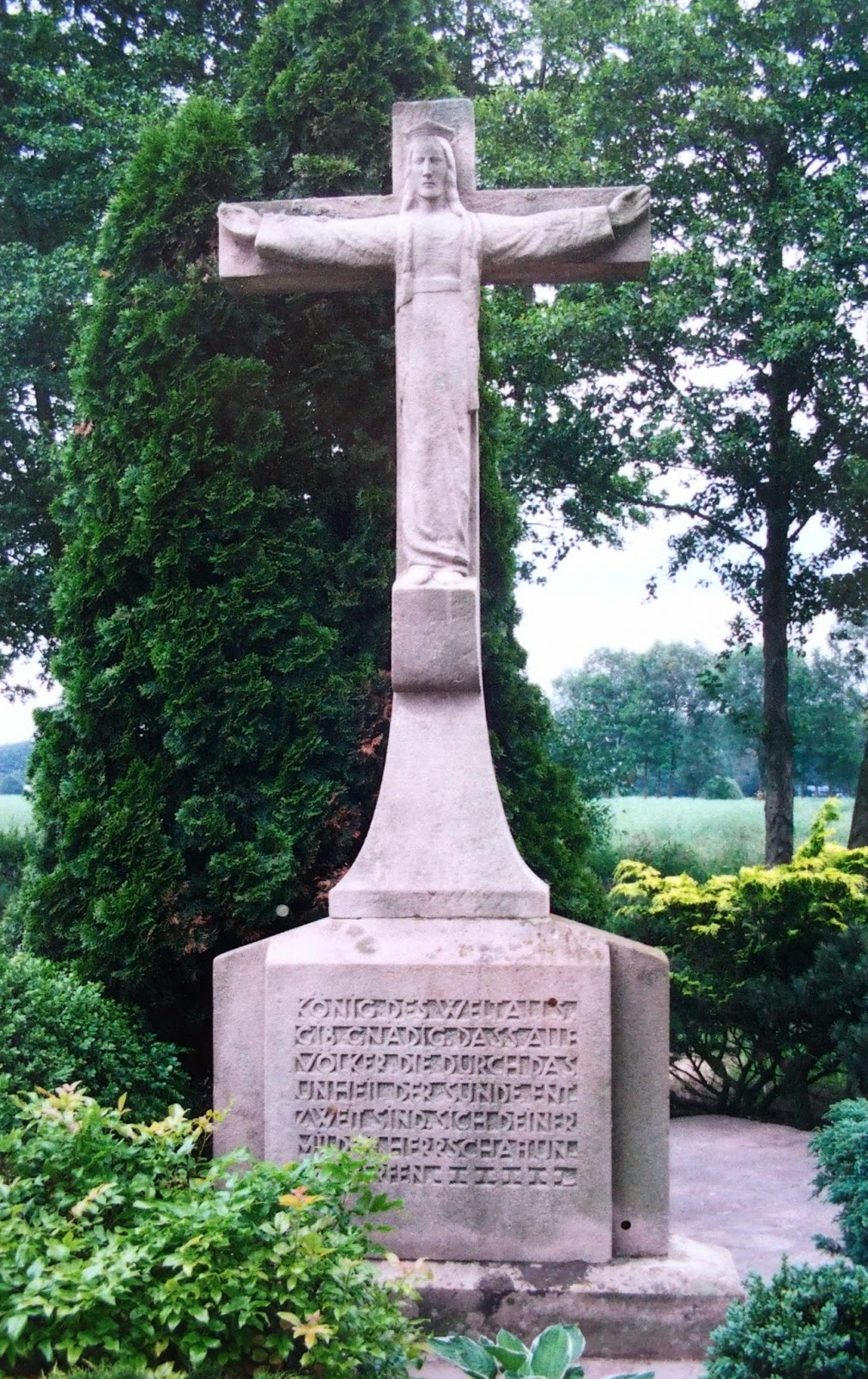
10. Diese Kreuz steht in oder bei Steinfeld am westlichen Rand des Bienwalds (ein von zahlreichen Gewässern durchzogener Ausläufer des Pfälzer Waldes, der sich weit in die Rheinebene hinein, über die deutsch-elsaässiche Grenze und bis ans Rheinufer ausdehnt) und nahe der französischen Grenze. Ich muss raten, aber von der Formensprache her würde ich das Kreuz mit einem gekrönten Christus ohne Bart aber dafür mit langen Haarflechten in die erste Hälfte des 20. Jh einordnen. Die Inschrift lautet: König des Weltallas, gib gnädig, dass alle Völker, die durch das Unheil der Sünde entzweit sind sich deiner milden Herrschaft unterwerfen.


11. Dieses liebevoll gepflegte Wegkreuz steht ebenfalls bei Steinfeld im Feld.


12. Christus in der Baumkrone. Auch diese verwitterte Statue von der man hier ein anderes Bild findet,  steht in oder bei Steinfeld.


34. Ein etwas zusammengepuzzelt wirkendes Friedhofs- bzw Grabkreuz in Schaidt, bei dem die Proportionen des Sockels für das kleine Kreuz etwas mächtig geraten scheinen - oder umgekehrt das Kreuz etwas klein für den Sockel. Vielleicht haben aber ja auch der Sockel oder Grabstein, die Muttergottes mit Weltkugel und Schlange, die Geisttaufe darüber und das Kreuz erst nach und nach zusammengefunden. Die Inschrift lautet: Hier ruhet in Gott Maria Anna Seintz (?) geboren den 23. Miertz( (?) 1804 gestorben den 6. Hornung 1826. Hornung ist ein altdeutscher Name für den Monat Februar.


35. Ein schönes Feld-Kreuz im Gegenlicht bei Schaidt, das ebenfalls am Westrand des Bienwalds liegt. Die Inschrift ist leider nicht lesbar.


43. Sandsteinkreuz mit herbstlichem Blumenschmuck bei Büchelberg, dem mit ca 900 Einwohnern kleinsten Ortsteil von Wörth am Rhein. Büchelberg ist vermutlich eine ehemalige "Gastarbeitersiedlung", die im 17. Jh für französische Arbeiter im Bienwald gegründet wurde, um für Luis XIV Holz und Kalkstein für den Bau von Fort-Louis im unteren Elsass zu gewinnen. Ein sprechendes Beispiel für die wechselhafte Geschichte der ganzen Grenzregion. Die Inschrift(en) sind leider auf dem Foto nicht lesbar.


44. Ein schönes Kreuz neueren Datums ebenfalls bei Büchelberg. Sollte es eine Inschrift geben, dann hat sie der Efeu verschluckt!


45. und noch eine herbstliche Aufnahme eines Kreuzes bei Büchelberg. Die Inschrift ist zwar teilweise vom Blumenschmuck verdeckt, doch ahnt man, wie es weitergeht: Nur im Kreuz - ist Heil

Freitag, 13. Juni 2014

Im Norden: Kreuze, barocke Nischenfiguren und eine Pietà in Zell und Boßweiler


2. dieses Holzkreuz vor blauem Dunst  steht in Zell beim Kriegerdenkmal. Zell ist ein Ortsteil von Zellertal, einer Weinbaugemeinde im Norden der Pfalz und gehört zum Donnersbergkreis. Den Höhenzug kann man im Dunst gerade noch erahnen. Das Kreuz ersetzt ein älteres, das gegenüber an der Stelle des 1928 für die im I. Weltkrieg Gefallenen errichteten Denkmals stand und vom hl. Philipp von Zell, einem Einsiedler dort aufgestellt worden sein soll.


3. dieses Kreuz in Boßweiler sieht so aus, als ob seine Teile aus mehreren "Epochen" stammen. Der Sockel ist wohl der älteste Teil; Querbalken und Korpus scheinen neueren Datums zu sein. Vielleicht war es schonmal zerstört worden?


4. Diese beiden Figuren stehen in Nischen über dem Hauptportal der barocken Pfarrkirche St. Oswald in Boßweiler, die einen der wertvollsten mittelalterlichen Altäre der Pfalz enthält, den sog. (wen wunderts?) Boßweiler Altar.
Interessantes Detail: Boßweiler und das benachbarte Quirnheim bildeten ab 1672 für eine Weile einen Zwergstaat


5. noch ein vermutlich aus verschiedenen Teilen zusammengesetztes Ensemble in Boßweiler: Sockel, die Platte samt Blumenkorbornamenten darin, Kreuz und Pietà sehen so aus, als habe man sich von keinem von ihnen trennen können und sie deshalb zusammengeführt. Gut so.
Die Inschriftenplatte scheint erst kürzlich erneuert worden zu sein. Die Inschrift lautet: Hl. Mutter drück die Wunden/Die dein Sohn für mich empfunden/Tief in meine Seele ein!